↑
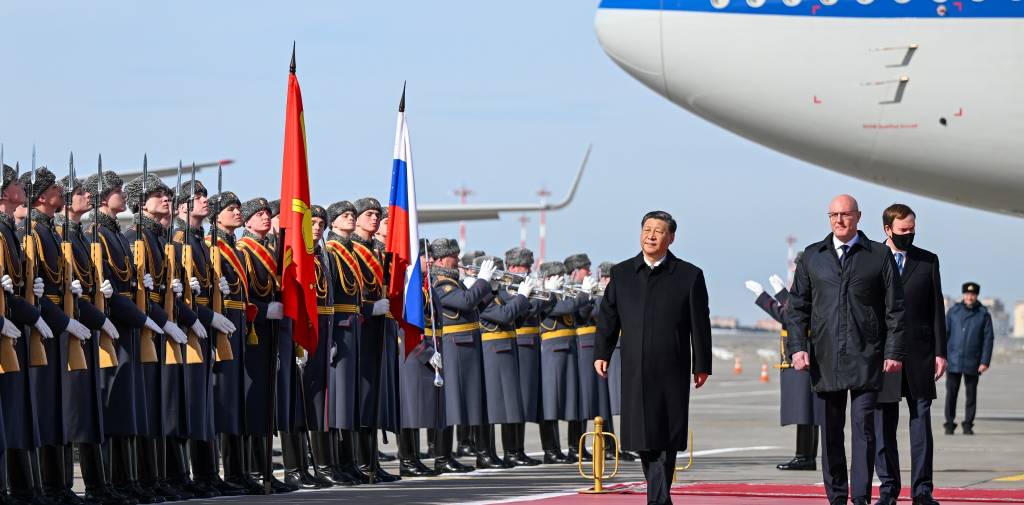
China’s President Xi Jinping is welcomed in Moscow on 20 March 2023. Image: Xie Huanchi / Xinhua / NTB
. . .

The partnership is built on mutual respect for the other’s core interests. Beijing expects Moscow to support its views on the Taiwan issue and that the Russian authorities restrict the scope for action of Taiwanese actors in Russia and elsewhere. Russia is also expected to clamp down on supporters of the 14th Dalai Lama and Falun Gong. Moscow expects China to refrain from undermining Russia’s war effort in Ukraine and back Russian ambitions for a new European security architecture in which NATO no longer accepts new members.
For Russia, the partnership provides an opportunity to develop a more robust military. Similarly, the PLA’s ability to operate in areas close to China is improved by procuring Russian military platforms and drawing on Russian experiences from the war in Ukraine.
Since 2022, Beijing has been mindful of the risk of Western secondary sanctions and adjusted the flow of capital, technology exports and trade with Russian actors accordingly. At the same time, this caution also forms part of a strategy to exploit Russia’s dependence in order to secure favourable bilateral agreements. The war has increased Russia’s reliance on China, further skewing the power dynamic between the two. Nevertheless, these factors do not threaten the general trajectory of the relationship.
Internationally, China and Russia will continue to cooperate on expanding multilateral forums such as BRICS and the Shanghai Cooperation Organisation, to counterbalance NATO and the EU. One particular goal is to diminish US international reputation and influence.
China and Russia in Africa
Beijing and Moscow view Africa as an arena for geopolitical rivalry with the West and have built substantial spheres of influence on the continent.
China has made considerable investments, including in infrastructure, energy and technology. In exchange, it obtains exclusive access to critical raw materials, which bolsters Chinese innovation and manufacturing capacity and reinforces its dominance of global supply chains. Moreover, Beijing is progressively converting its influence on the continent into political backing in international forums.
In the past, China primarily involved itself in relatively stable areas, particularly in southern and eastern Africa. More recently, the regime has increased its involvement in the conflict-ridden Sahel region, where Western actors have largely been forced out. Weak government control of natural resources offers Chinese companies considerable opportunities for profit.
Protection requirements have led to security cooperation with Sahel’s authoritarian regimes, which also import large amounts of light military equipment from Chinese manufacturers. China’s growing footprint provides access to new markets for Chinese defence industry and companies with limited access to Western markets. Moreover, China has become a major supplier of surveillance and telecoms technology in North and West Africa.
Russia has in recent years forged ties with a number of African states that were formerly Western allies, aiming to secure strategic partnerships and long-term dependencies.
Moscow, far more than China, has shown a willingness to become directly involved in armed conflicts for economic and political gain, and maintains a significant military presence in several African countries. Russia’s involvement reinforces authoritarian tendencies, and in areas under strong Russian influence it becomes virtually impossible for international organisations to run projects related to human rights and democracy.
Russian gas exports to China
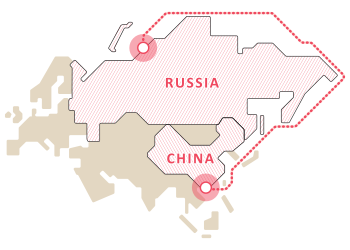
China currently receives gas both via the Russian LNG (liquefied natural gas) shadow fleet and through the pipelines that run between the two countries.
In the autumn of 2025, China began receiving shipments from the sanctioned Russian Arctic LNG 2 facility. This decision signals a shift in Beijing’s risk calculations, with China testing the West’s willingness to enforce sanctions.
In 2025, China took delivery of at least 22 LNG shipments, 21 of which came from Arctic LNG 2. All of the shipments were routed to the same terminal, allowing China to avoid exposing other terminals to sanction risk.
According to Gazprom’s own reports, in 2025 it supplied 38.8 BCM (billion cubic metres) of gas to China via the Power of Siberia 1 pipeline – the first time more gas was supplied to China than to Europe (including Türkiye). 2025 was also the first year Power of Siberia operated at planned full capacity.
China and Russia are continuing negotiations on the establishment of a new gas pipeline (Power of Siberia 2). Once completed – expected sometime in the 2030s – the capacity for Russian gas exports to China will nearly double.
Despite sanctions, China remains Russia’s main trading partner
China makes a significant contribution to Russia’s state finances. In addition to consumer goods, China exports components and technology that are instrumental to Russian war‑fighting.
Trade between China and Russia grew steadily from the mid‑2010s and accelerated markedly after Russia’s assault on Ukraine. In 2024, total bilateral trade reached almost USD 245 billion – more than double the 2020 level. In 2025, trade fell for the first time in five years, to approximately USD 228 billion. This represents a natural stabilisation of trade levels, driven in particular by fluctuating energy prices. Both sides are facilitating further growth towards 2030, aiming for a substantial benchmark of USD 300 billion, including through upgrades of transport infrastructure.
Both parties will nevertheless aim to shift the focus away from consumer imports towards joint ventures and technological cooperation, with the aim of reducing vulnerability to Western sanctions. Moscow and Beijing are continuously seeking new ways to circumvent sanctions, and China is particularly set on shielding its Western‑exposed Chinese enterprises from risk. Beijing is using the West’s sanctioning of Russia to learn, and the cooperation with Moscow provides opportunities to test different circumvention mechanisms.
The trade balance between China and Russia is relatively even, with the two economies complementing each other across different product groups. While China exports manufactured and consumer goods, Russian exports to China consist mainly of energy and other natural resources. Russia’s reliance on these exports is a weak point in its economy, and particularly vulnerable to a decline in Chinese demand.
China is the world’s largest importer of Russian energy, with crude oil being Moscow’s biggest source of revenue. Energy cooperation has strengthened in recent years, and China benefits from importing sanctioned Russian energy at low prices.
Military partnership strengthened in several areas
China and Russia will continue to deepen their military cooperation in 2026 through joint exercises and increased defence industry exchanges. Over the past few years, the two countries have conducted progressively larger and more complex joint exercises, incorporating new elements. The two military powers still have limited interoperability, and the primary aim is strategic signalling to the United States and its allies. Nevertheless, Chinese forces in particular gain valuable experience from real‑world operational environments and have the opportunity to train alongside a far more seasoned military power.
Defence industry cooperation will also be deepened in the coming years, but the parties will attempt to keep the contents of the partnership concealed. Russia has been a key contributor to China’s defence modernisation for years. Moscow seeks to remain a significant supplier of key materiel and to provide capabilities and expertise that could prove important to operations around Taiwan. For Russia, the Chinese drone industry is vital to the development and production of its own attack drones and for devising counter‑measures against Ukrainian drones.
Beijing is prepared to go to great lengths to support Moscow in order to prevent a Russian defeat in Ukraine. China remains the single most important supplier of non‑lethal military materiel and dual-use items to the Russian defence industry. This ranges from raw materials and parts to advanced technology and computer‑controlled production equipment, and is central to Russia’s military capability. Nevertheless, Beijing will continue to calibrate its assistance to avoid being subjected to Western sanctions.
If Beijing assesses the risk of secondary sanctions to have come down, the Chinese defence industry is expected to contribute even more substantially to Russian military modernisation, for example by supplying more complete systems. Combined with technological innovations emerging from a nascent development partnership with China, this will allow new components, unfamiliar to the West, to be phased into Russian weapons.