↑
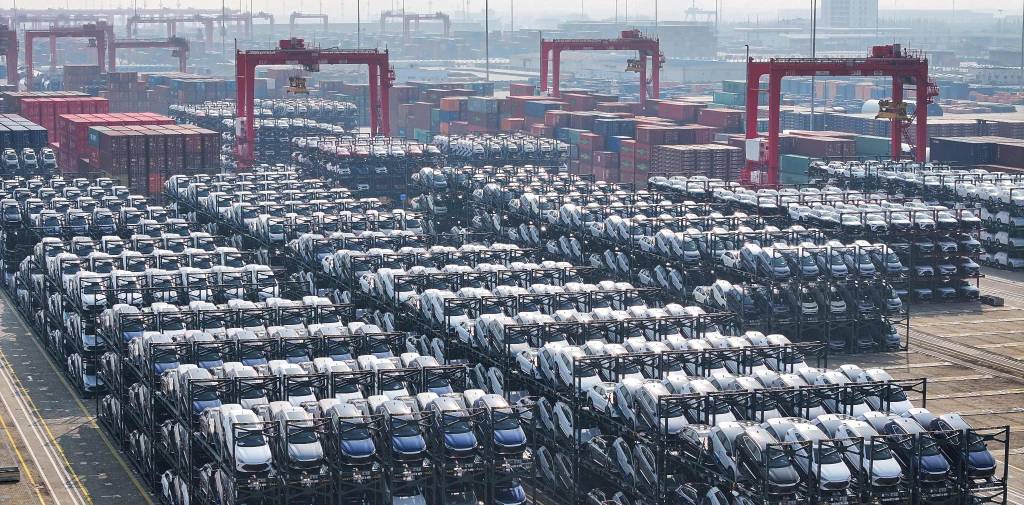
Electric cars from the Chinese manufacturer BYD are ready to be shipped in Suzhou, China, 16 January 2026. Image: AFP / NTB
. . .

↑
. . .
Beijing and Washington have both identified the other as the greatest threat to their respective national security, and Beijing considers rivalry with a Western world led by the US to be China’s main geopolitical challenge. In this context, Beijing works closely with Moscow, which shares China’s goal of reducing the West’s power to dictate the terms of international relations and the United States’ leading position globally.
Over time, the Chinese regime has worked to make its economy more resilient to sanctions, and China’s capacity to withstand external pressure has improved. The trade war with the United States has acted as a stress test for the Chinese economy, which has proven robust in the face of high US tariffs.
China has secured a dominant position in supply chains covering defence materiel, technology development and energy. Europe’s need for military rearmament and its ambition for a green transition require access to many of the supply chains that China controls. For Beijing, other countries’ dependence on Chinese imports offers scope for action. China will seek to exploit the situation to strengthen its position vis‑à‑vis individual states and to undermine any attempts to create a unified European bloc for handling China‑related issues.
Trade policy as instrument for global influence
China is positioning itself as a great power, mobilising support for its efforts to change the current world order. China seeks to present itself as a stable, predictable and reliable partner, and as an alternative to the United States.
Emphasis on non-intervention has made cooperation with China attractive to several countries. Beijing does not require partners to strengthen democratic institutions or human rights. However, China dictates the terms for cooperation, which have to benefit China economically as well as politically.
New ventures in Europe offer greater scope for action
China’s large ownership stakes across a variety of supply chains are illustrative of its approach. For example, Chinese firms are investing in the extraction of metals and minerals used in electronics and batteries. Chinese state-owned enterprises have a substantial global footprint in minerals and mining, while the Chinese authorities simultaneously promote investment cooperation and trade cooperation.
In Europe, China’s investment in electric cars has led to a series of new battery manufacturing plants. This is an example of geographic dispersal of production facilities, which spreads China’s exposure to regulatory measures and makes it easier to circumvent them. The flexibility this offers is reinforced by far‑reaching control of certain supply chains and by support through government mechanisms.
Control of large parts of a supply chain makes it very difficult for other actors to develop competitive alternatives in the short term. This is something that the Chinese authorities are well aware of and will seek to exploit.
An alternative international community emerging
Beijing is devoting considerable effort to reshaping international institutions and norms to align them with China’s core interests and great power ambitions. The existing world order is portrayed as an outdated system where the needs of the global south always come last.
China continues to promote alternative multilateral arenas, including BRICS and the Shanghai Cooperation Organisation (SCO), as counterweights to the established forums.
In addition, Beijing has in recent years launched a set of global initiatives which, in combination with the Belt and Road Initiative (BRI), provide the framework for an alternative global governance model:
Beijing seeks to use these initiatives to guide a reform of the United Nations. They are presented as being for the common good of the international community, with territorial sovereignty, economic cooperation and the principle of non intervention at their core.
Near monopoly on critical minerals and rare earth elements
Minerals are natural, solid substances that are typically extracted by mining. Some are used directly in manufacturing processes, while others are processed into metals, or rare earth elements are extracted from them. The latter have certain properties, such as mechanical strength, electrical conductivity and magnetic or optical properties, which are essential to many technological products.
Beijing aims to increase the West’s dependence on Chinese goods and inputs, with the aim of expanding China’s political and economic power. China’s position in the extraction of rare earth elements and other critical minerals is central to this effort.
China controls around 60 per cent of global extraction of rare earth elements and a significant share of several critical minerals. The country also accounts for 85–90 per cent of refining and processing. No other country is expected to be able to challenge China’s position in the next five to ten years.
By imposing export restrictions on rare earth elements, the Chinese authorities are limiting the West’s ability to develop military equipment and advanced technology, and to build infrastructure for completing the green transition.
Persistent intelligence and influence threat to Europe
Several instances of Chinese intelligence and influence activities in Europe have come to light in recent years. These activities have taken place in the United Kingdom, Belgium, Germany, Estonia and Sweden, and in most instances the individuals involved were citizens of the country where they carried out their assignments. The cases include attempts to obtain sensitive political information, surveillance of Chinese expats and efforts to influence politicians. The most prominent topics have been trade policy, Taiwan and the human rights situation in China.
Chinese intelligence services have been collecting intelligence and pursuing dissidents and Chinese minorities across Europe for several decades. Chinese cyber actors carry out operations against the West primarily to exfiltrate data, but ultimately also to be able to inflict damage. Compromise attempts have targeted both public and private sectors, with technology and electronic communication manufacturers being especially vulnerable. China employs a network of private companies to obscure any direct links to the state. In addition, there have been examples of Chinese cyber actors positioning themselves in Western infrastructure; such access could potentially be used to inflict damage during times of heightened tension.

The Ministry of State Security (MSS) and the Ministry of Public Security (MPS) are the most active Chinese services operating in Europe.
Their methods span from traditional human intelligence to sophisticated operations in cyberspace.
They are adaptable, and exploit opportunities as and when they arise.
Modernisation of PLA geared toward centenary celebration
In 2027, it will be one hundred years since the foundation of China’s armed forces, the People’s Liberation Army (PLA). For Beijing, this is a milestone on the path to ’a world‑class military’ by 2049. In recent years, China’s defence budget has increased by about seven per cent annually, and it is expected to continue growing at the same pace. This means larger and more realistic exercises, integration of new technology and further development of network-centric warfare.
China’s civilian industry makes rapid modernisation possible. One example is the country’s ship‑building capacity. China currently builds more than half of all ships worldwide. With around 400 combat and auxiliary vessels, the Chinese navy is the largest in the world in terms of number of ships, and it is set to expand further in the years to come. An aircraft carrier capable of operating large drones and helicopters is due to be delivered to the navy in 2026 or early 2027. Construction has also begun on China’s fourth aircraft carrier, and work on quieter submarines continues.
The PLA nonetheless faces certain challenges. The forces lack combat experience, and the PLA’s ability to perform in an armed conflict remains untested. In addition, the capability to interact during combat is limited. Many of the exercises designed to showcase interoperability are scripted, and parts of the PLA are hampered by outdated materiel; for example, the bomber fleet consists of ageing aircraft with short range.
PLA seeks capability to incorporate Taiwan by force
Beijing maintains that Taiwan is an inseparable part of China, and reunification with the mainland is central to China’s great power ambitions. China aims to coerce Taipei into making concessions without unilaterally escalating to an armed conflict, and to deter other states from getting involved in the Taiwan issue. One manifestation of this is the expansion of Chinese joint exercises close to Taiwan.
Beijing has normalised a high level of training activity around the island. There are almost daily operations both at sea and in the air, in addition to one or two large‑scale annual exercises that bring together multiple services and theatre commands. In December 2025, China conducted the second major blockade exercise around Taiwan that year, shortly after the United States announced its largest ever arms sale to the island. Activity around Taiwan is expected to continue increasing.
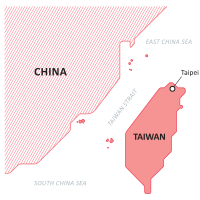
The situation in the Taiwan Strait has intensified, with a growing risk of accidents and misunderstandings.
Due to distrust between Washington and Beijing, incidents in the Taiwan Strait are more likely to escalate, which risks pulling the two parties into armed conflict.
This would disrupt international trade and may have enormous consequences for the world economy. A conflict would shift US political attention and military resources away from Europe and other parts of the world towards Asia.