↑
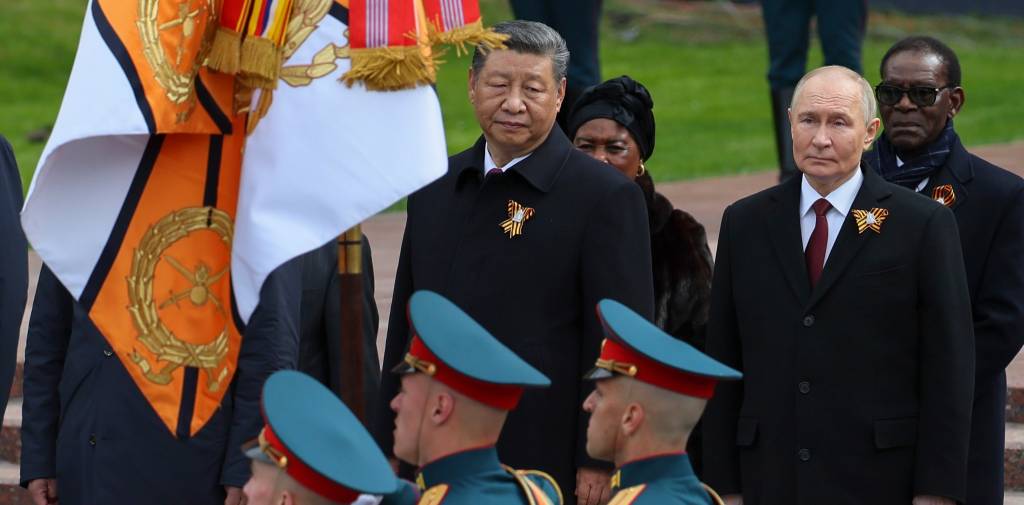
China’s President Xi Jinping and Russia’s President Vladimir Putin attend a wreath-laying at the Tomb of the Unknown Soldier during the Victory Day celebrations in Moscow on 9 May 2025. Image: Yuri Kochetkov / AP / NTB
. . .
↑
. . .
Overt self-interest and wilful conduct are on display in the Arctic as well. Moscow and Beijing are paying close attention to Washington’s statements regarding Greenland. Changing the status quo in the Arctic carries a risk of both Russia and China rethinking their ambitions and conduct in the region.
The return of spheres of influence is just one aspect of the larger upheaval Norway is facing. There are other developments that will also come to have wide-ranging consequences for Norwegian interests.
Another form of geopolitics
There are a number of states that are seeking a less norm-based approach to transnational issues. The undermining of international institutions set up in the wake of the Second World War allows for multilateral organisations such as SCO and BRICS to come forward. China, as the leading proponent, claims to represent a value-neutral diplomacy founded on non-intervention and state sovereignty, which is nonetheless based on great power interests. China, Russia and Iran are also erecting alternative financial structures to make themselves less dependent on the US dollar and Western economy, and more resilient in the face of Western policies.
Political conduct based on military power and authoritarian cooperation
In Europe, the war in Ukraine remains a clear and brutal expression of Russian power politics. It has precipitated the greatest defence reorganisation in Europe since the start of the Cold War. The Kremlin believes it is possible to re-establish itself as a great power, with military might as its key political instrument. Domestic policy is becoming increasingly authoritarian, while cooperation with other authoritarian states is expediting Russia’s withdrawal from the rest of Europe.
Small states, smaller scope for action
Growing use of military force, coercion and threats by the great powers reinforces Russian and Chinese narratives of how international politics actually work. A rising number of countries are joining a community of authoritarian states, led by President Xi. The military parade in Beijing on 3 September last year illustrated this perfectly: Xi led a procession of heads of state who stand in opposition to a perceived Western hegemony. Faced with this development, more states are also finding neutrality the better option.
Accelerating arms race and deterrence
The balance of power between the nuclear powers is shifting. China has achieved continuous second-strike capability, and is driven by an ambition to achieve parity with the United States. For Russia, the introduction of new types of nuclear weapons and other strategic weapons is intended to offer added deterrence and escalation options. In lieu of new arms treaties, test activity may increase in the longer term, as may the number and types of Russian nuclear weapons on the Kola Peninsula. Rising tensions could also trigger an increase in Russian military activity and strategic deterrence close to Norwegian borders.
Higher investment and trade risks
Investments and international trade are characterised by growing protectionism and resource security concerns, such as access to critical raw materials and control over infrastructure. Global dependencies that have been touted as advantageous from a security policy standpoint since the 1980s are now being identified as systemic weaknesses. Beijing believes European countries have little resilience in the face of Chinese dominance over global supply chains. China’s activity and positioning is not just intended to serve current Chinese interests, but also to create further dependencies that could collectively offer China a decisive advantage in any future conflict. Russia, for its part, considers European society’s dependency on digital solutions to be susceptible to various forms of coercion.
Russia and China in the Arctic